Exercise Does More Than Move Muscles It Moves Mitochondria

- Details
- Published on 23 December 2025
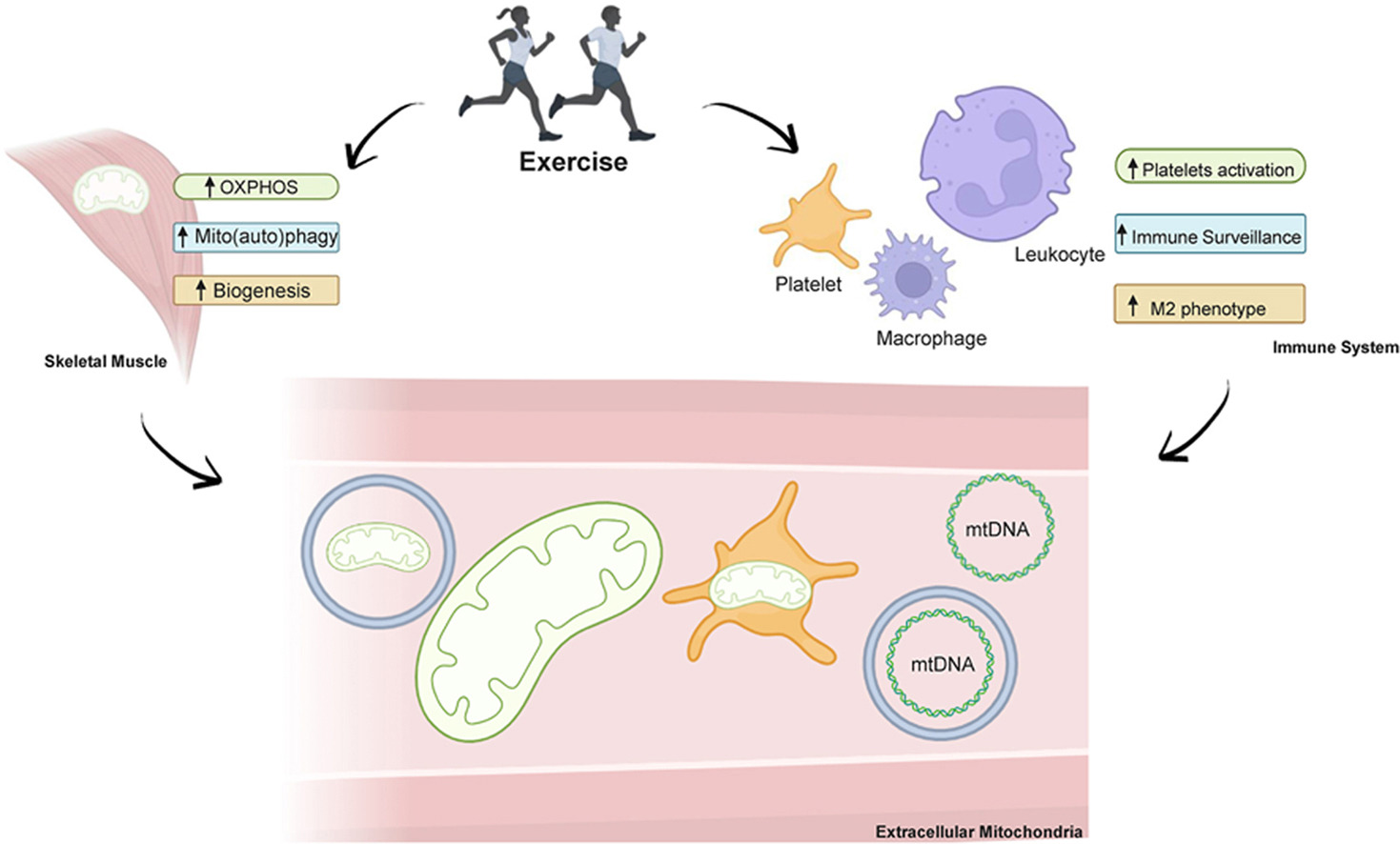
For decades, mitochondria have been described as the cell’s powerhouses - essential for energy production, yet largely silent and confined inside the cell. A new scientific review invites us to rethink that view. It suggests that exercise may do something far more profound: set mitochondria in motion and turn them into systemic messengers of health.
The review explores growing evidence that physical activity can lead to the presence of mitochondria, or mitochondrial components, in the bloodstream. These extracellular mitochondria appear in different forms - sometimes free, sometimes associated with vesicles or blood elements - pointing to a complex and still largely unexplored mode of biological communication triggered by movement.
Exercise has long been known to reshape mitochondria within muscles, the heart, and the brain. What is new here is the shift in perspective. Instead of focusing only on what happens inside cells, the authors look at what may happen between organs. The idea that mitochondria could circulate and carry signals fits with a more modern, systemic understanding of physiology, where health emerges from coordination rather than isolation.
Until now, circulating mitochondrial material has often been viewed through the lens of stress or damage, particularly mitochondrial DNA. This review challenges that narrow interpretation. It raises the possibility that extracellular mitochondria are not just by-products, but active participants in biological signaling, potentially influencing inflammation, metabolism, immune balance, and adaptation to physical effort.
Many questions remain unanswered. Where do these circulating mitochondria come from? Are they functional? Do they signal resilience, adaptation, or cellular strain - or all of these depending on context? What is clear is that this field is still in its early stages, and its implications could be far-reaching.
What makes this work especially timely is its resonance with a broader shift in medicine. Health is no longer seen as static, nor disease as purely organ-based. Instead, attention is turning toward dynamic processes, communication networks, and resilience mechanisms. In this context, mitochondria are no longer just engines of energy. They become messengers, carrying information about physiological state and adaptation.
Seen through this lens, exercise is not simply about movement, performance, or calorie expenditure. It may be a way of activating a circulating mitochondrial dialogue, coordinating responses across tissues and shaping long-term systemic health.
In the spirit of WMS 2026, this review does more than add a new mechanism. It opens a new way of thinking: What if movement speaks the language of mitochondria and mitochondria carry that message throughout the body?