Mitochondria Help Control Skin Pigmentation: A New Organelle Dialogue Revealed

- Details
- Published on 27 April 2026
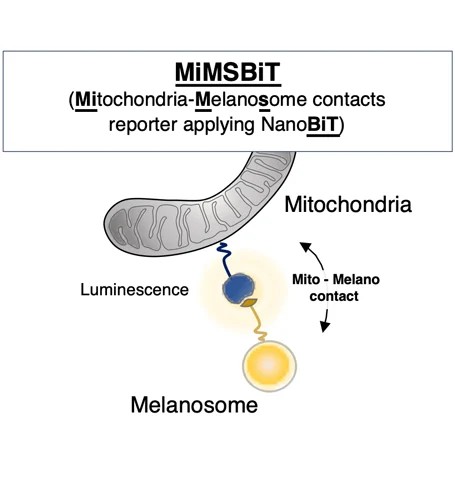
- Schematic overview of MiMSBiT, a reversible system for quantifying mitochondria–melanosome contacts in living cells.
A new study by Shigeru Yanagi, Isshin Shiiba and colleagues from the University of Tokyo shows that mitochondria do more than produce energy: they physically communicate with melanosomes, the organelles responsible for producing and storing melanin.
Researchers developed a new live-cell tool called MiMSBiT, allowing them to measure contacts between mitochondria and melanosomes in real time. Using this approach, they found that mitochondria directly interact with melanosomes and provide ATP locally, supporting melanosome maturation and melanin production.
The study, published in Nature Communications, identifies a molecular bridge involving STIM1 on melanosomes and Mitofusin 2 / MFN2 on mitochondria. When this contact is disrupted, melanosome maturation is impaired and melanin synthesis decreases.
This discovery adds a new dimension to pigmentation biology. Skin color and pigment changes are not only controlled by enzymes and hormones; they also depend on organelle communication inside the cell. Mitochondria appear to act as local energy and signaling partners, helping melanosomes reach the correct stage of maturation.
The implications may extend beyond basic pigmentation. The authors suggest that these findings could support future research on aging-related pigment changes and pigmentation disorders.
Impact on mitochondrial medicine
This study reinforces a central message of modern mitochondrial biology: mitochondria are not isolated power plants. They are communication hubs, interacting with other organelles to regulate cell identity, adaptation, and function.
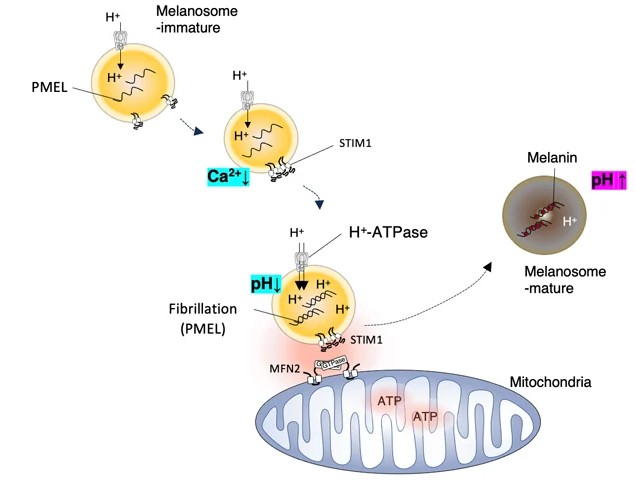
Mfn2 on mitochondria and STIM1 on melanosomes mediate mitochondria–melanosome contact, promoting melanosome maturation and facilitating melanin pigmentation.
At Targeting Mitochondria 2026, this type of discovery will be central to discussions on mitochondrial intelligence, organelle communication, aging, and new therapeutic strategies. This topic will be discuss also Skin Challenge 2026.
Read the complete news by Shiiba, I., Ishikawa, Y., Oshio, H. et al. STIM1-Mitofusin2 interactions tether mitochondria and melanosome contacts that promote melanosome maturation. Nat Commun 17, 3593 (2026). here