Can Mitochondria Create New Organelles? A Discovery Reopens a Major Question in Cell Biology

- Details
- Published on 28 April 2026
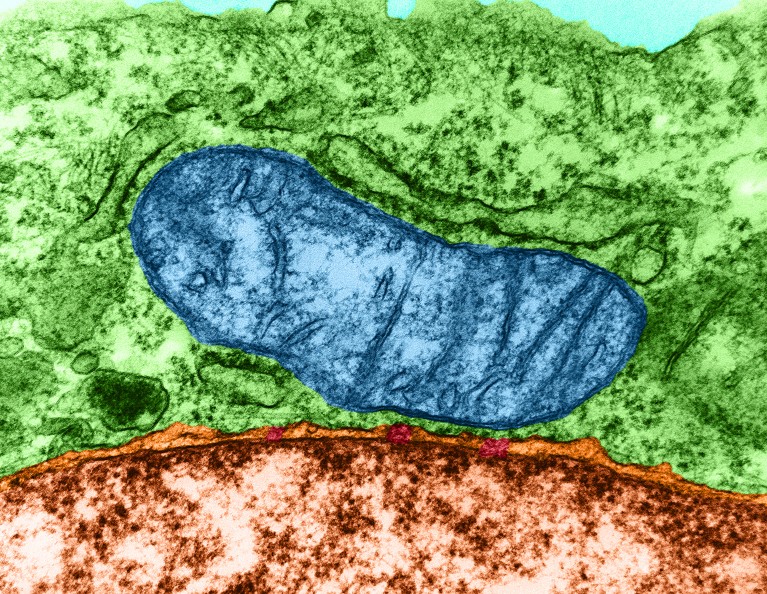
- Researchers are discovering that mitochondria (blue), known as cells' power plants, also play parts in cells' immune responses.Credit: David M. Phillips/Science Photo Library
A new report in Nature, written by Viviane Callier, describes a provocative discovery: when the parasite Toxoplasma gondii invades host cells, mitochondria respond by shedding their outer layers to form new cellular compartments that can digest molecular waste. The article reports on a 2026 bioRxiv preprint by Lena Pernas, Xin Li, Yue Sun, and José M. Delgado.
This observation goes far beyond classical mitochondrial dynamics.
Mitochondria are usually presented as energy-producing organelles. They are also recognized as regulators of immunity, redox signaling, stress adaptation, and cell death. This new work adds a more radical possibility: mitochondria may actively participate in building new cellular architecture.
The discovery raises three strategic questions for the field.
First, mitochondrial immunity.
Mitochondria do not simply suffer during infection. They sense danger, reorganize their membranes, communicate with immune pathways, and may now be viewed as contributors to the formation of defense-associated compartments.
Second, organelle evolution.
The finding supports a broader evolutionary hypothesis: ancient mitochondria may have helped shape the internal compartmentalization of modern eukaryotic cells. In other words, mitochondria may not only be descendants of bacteria. They may also have been architects of cellular complexity.
Third, mitochondrial intelligence.
This discovery reinforces one of the central messages of Targeting Mitochondria 2026: mitochondria are not passive power stations. They are adaptive, communicative, and structurally dynamic organelles able to influence cell fate under stress.
This topic strongly fits the spirit of Targeting Mitochondria 2026, where the World Mitochondria Society will explore mitochondria as decision-making hubs in immunity, infection, organelle communication, aging, and disease vulnerability.
Key question:
Are mitochondria only organelles, or can they also generate new cellular organization?
Read the complete news here
Read the news on LinkedIn