Nanoflowers help cells share mitochondria and restore energy


- Details
- Published on 10 February 2026
Scientists at Texas A&M University have developed an unusual tool to help damaged and aging cells recover their energy: microscopic particles called “nanoflowers.” These tiny structures can stimulate stem cells to produce and share mitochondria with neighboring cells, restoring cellular energy production.
Mitochondrial decline is a central feature of aging, neurodegeneration, and cardiovascular disease. When cells lose mitochondria, their ability to produce energy drops, leading to reduced function and increased vulnerability to stress.
In this new study, researchers combined stem cells with flower-shaped nanoparticles made of molybdenum disulfide. The particles stimulated stem cells to produce about twice as many mitochondria as normal. These “mitochondrial bio-factory” cells then transferred the extra mitochondria to nearby damaged or aging cells.
The results were striking: recipient cells recovered energy production, improved survival, and resisted stress-induced cell death, including damage from chemotherapy like conditions.
While cells naturally exchange mitochondria at low levels, the nanoflower approach increased mitochondrial transfer by two- to four-fold, suggesting a way to amplify a natural repair mechanism rather than replace it.
Because the nanoparticles remain inside cells longer than conventional small molecule treatments, the approach could potentially enable long-lasting mitochondrial support therapies with less frequent dosing.
Although still at an early stage, the technology points toward a new regenerative strategy: boosting mitochondrial sharing between cells to restore tissue energy and resilience. Researchers suggest this approach could eventually be explored for conditions ranging from cardiomyopathy to neurodegenerative disease and muscle degeneration.
For the mitochondrial field, the study reinforces a growing idea: mitochondria are not only intracellular powerhouses, they are also transferable biological resources that can support tissue repair and cellular recovery.
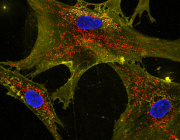
About Image
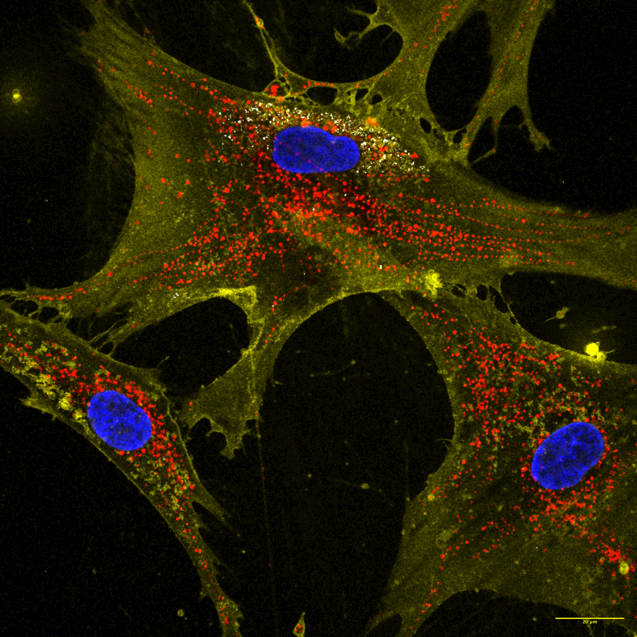
Microscopic image showing how nanoflowers (white) help healthy cells (yellow) deliver energy-producing mitochondria (red) to neighboring cells. Nuclei are stained blue.
Courtesy Dr. Akhilesh K. Gaharwar.
Referance
Texas A&M University (2025). Texas A&M scientists use "nanoflowers" to recharge aging and damaged cells.
Read the full article