Can Cancer Cells Use Mitochondria to Escape Chemotherapy?


- Details
- Published on 23 July 2026
A new study identifies mitochondrial plasticity as a targetable mechanism of resistance to 5-fluorouracil
Drug resistance remains one of the greatest barriers to effective cancer treatment. In colorectal cancer, 5-fluorouracil (5-FU) has been a cornerstone of chemotherapy for decades, yet many tumours respond poorly or eventually become resistant.
A study published on 23 July 2026 in Nature Metabolism now reveals how colorectal cancer cells can rapidly reorganize their metabolism to survive this treatment and how this adaptation might be blocked.
Cancer cells do not simply survive they adapt
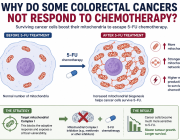
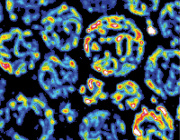
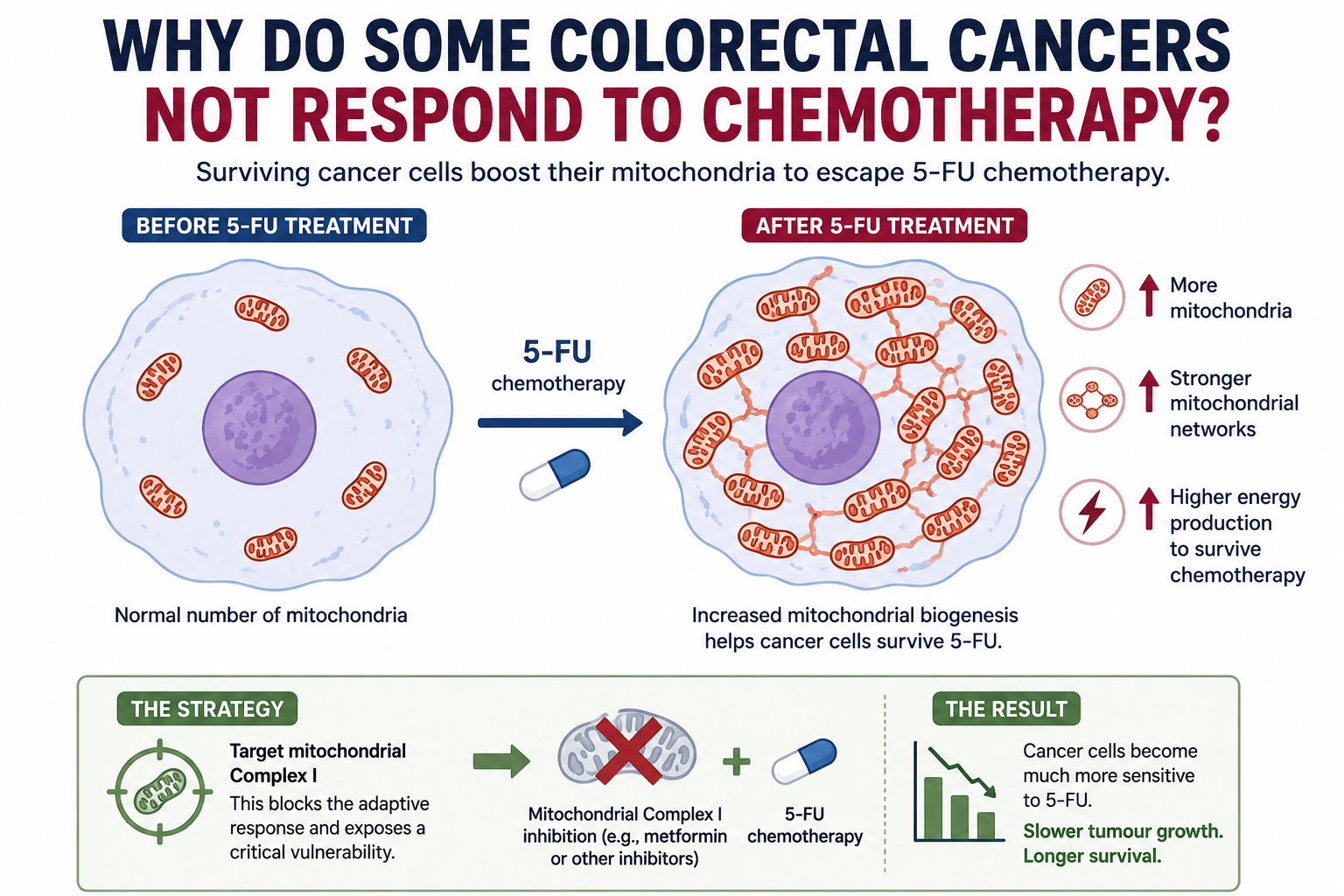
The researchers found that colorectal cancer cells surviving 5-FU rapidly increase their mitochondrial content and activity.
Their mitochondria become more abundant, more interconnected and more metabolically active. This mitochondrial biogenesis increases Complex I activity, ATP production and tricarboxylic acid cycle metabolism, providing the energy required for cancer cells to manage the nucleotide stress caused by chemotherapy.
The mechanism appears to involve the inhibition of thymidylate synthase by 5-FU, followed by activation of an mTOR–PGC-1α mitochondrial biogenesis programme.
This programme supports the ATP-dependent enzyme UCK2, which allows surviving tumour cells to recover pyrimidines and restore the nucleotide balance required for continued survival.
In simple terms, chemotherapy creates a metabolic crisis but the cancer cells respond by building a stronger mitochondrial support system.
A new therapeutic vulnerability
This adaptation also creates a weakness.
When the researchers inhibited mitochondrial metabolism particularly electron transport chain Complex I colorectal cancer cells became substantially more sensitive to 5-FU.
Across cellular, organoid and animal models, combining 5-FU with mitochondrial inhibition increased cancer-cell death, delayed tumour growth and prolonged survival.
Importantly, the mitochondrial response was stronger in cancer cells than in surrounding stromal cells. This suggests that chemotherapy may make tumour cells temporarily more dependent on oxidative metabolism, potentially opening a therapeutic window in which mitochondrial inhibitors could be used at lower and safer doses.
Why metformin is strategically interesting
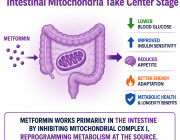
The researchers used metformin as a proof-of-concept Complex I inhibitor.
Metformin is inexpensive, orally administered and has a well-established safety profile. It could therefore represent a practical candidate for combination with infusional 5-FU.
However, the findings remain preclinical. Previous studies of metformin in colorectal cancer have produced inconsistent results, often because patients were not selected according to tumour metabolism, disease stage or treatment context.
The strategic lesson is therefore not that metformin should be broadly added to chemotherapy.
It is that mitochondrial metabolism may help identify the patients most likely to benefit from a metabolically targeted combination.
From empirical combinations to precision oncology
Current colorectal cancer chemotherapy combinations were largely developed empirically. The new findings support a more rational strategy based on tumour biology.
Three translational directions emerge:
1. Identify high-risk tumours
Tumours with elevated oxidative-phosphorylation signatures may be intrinsically less sensitive to 5-FU. In the patient cohort studied, high oxidative-metabolism signalling was associated with poorer outcomes following fluoropyrimidine-based chemotherapy.
Mitochondrial activity could therefore become a biomarker for patient stratification.
2. Measure the metabolic response to treatment
An increase in mitochondrial biogenesis after an initial chemotherapy exposure could indicate that the tumour is activating a survival programme.
This adaptive response might be used as a dynamic biomarker to determine when mitochondrial inhibition should be introduced.
3. Design biologically selected combinations
Rather than testing mitochondrial inhibitors in unselected populations, future clinical trials could focus on patients whose tumours show high oxidative metabolism or strong chemotherapy-induced mitochondrial biogenesis.
This approach may improve efficacy while avoiding unnecessary toxicity in patients unlikely to benefit.
Beyond colorectal cancer
The implications may extend beyond 5-FU and colorectal cancer.
The researchers observed similar mitochondrial adaptations following treatment with other thymidylate synthase-targeting agents, including pemetrexed and methotrexate, in lung cancer models.
Because millions of patients receive thymidylate synthase inhibitors each year, targeting mitochondrial adaptation could potentially improve treatment responses across several cancers.
A changing view of chemotherapy resistance
This study challenges the idea that drug resistance is only driven by fixed genetic mutations or the selection of pre-existing resistant clones.
Resistance can also begin as a rapid and reversible metabolic adaptation.
Cancer cells survive by reshaping their mitochondria, increasing energy production and restoring the metabolites depleted by treatment.
The strategic message is clear:
Mitochondria are not simply powering tumour growth. They may actively determine whether chemotherapy succeeds or fails.
The work was led by Emma M. Kerr and colleagues, with Deborah Y. Moss, Connor N. Brown and Andrew M. Shaw contributing equally as first authors. The authors report that a clinical trial evaluating this therapeutic strategy in patients with colorectal cancer is now in development.
Read the full news here
Read the news on LinkedIn